The DJI L3 Is Incredible. Here's Why We're Not Worried.
Apr 01, 2026
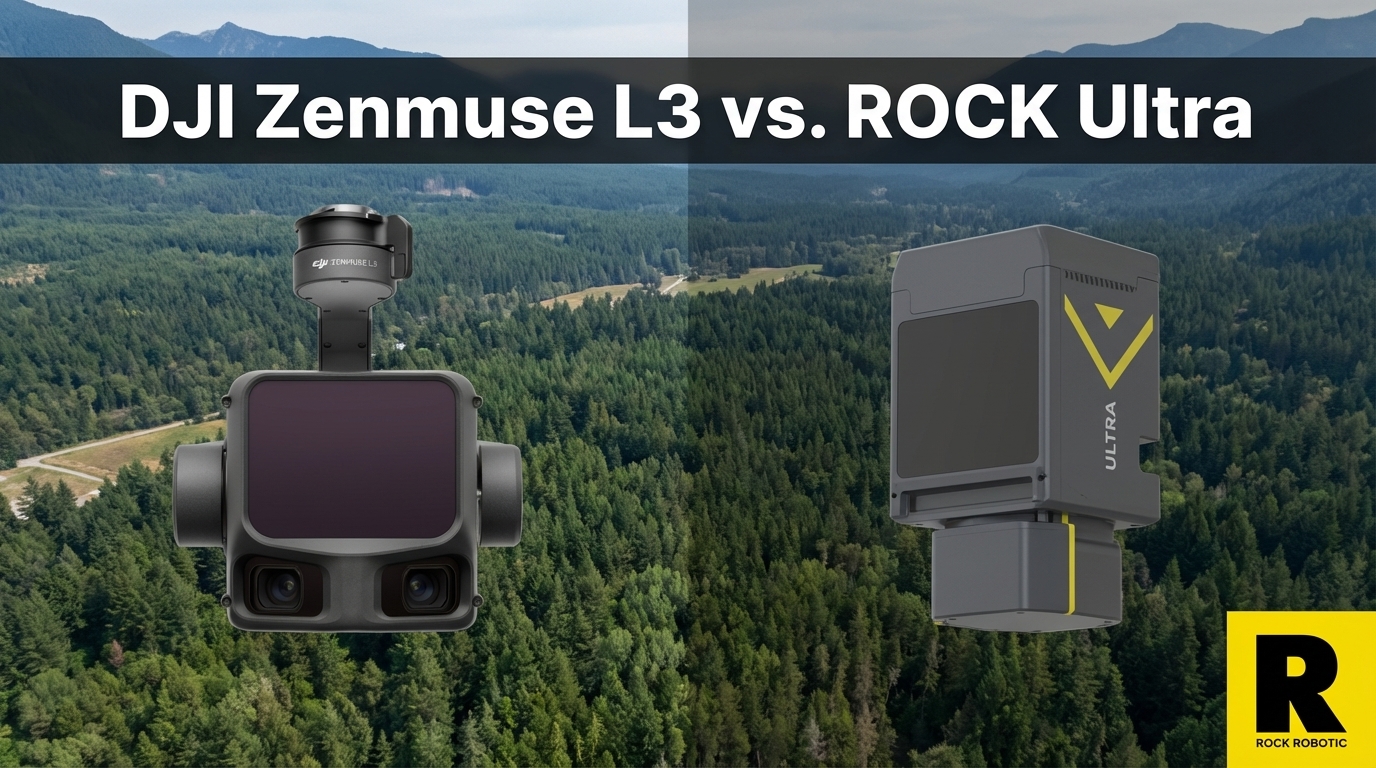
When DJI dropped the Zenmuse L3 in November 2025, the LiDAR world collectively leaned forward. A 1535 nm sensor at $17,400. Up to 2 million points per second. Dual 100 MP cameras. A 0.01° IMU. Specs that cost $150,000+ just two years ago, now under $20K.
We're going to say it plainly: the L3 is an impressive piece of hardware.
We're also going to say something that might surprise you coming from ROCK Robotic: it's not the right tool for every survey business. Not even close.
Here's our honest breakdown — what DJI got right, and the six things the L3 still can't give you.
What DJI Got Right
Let's be fair. The L3's specs are legitimately impressive:
- 1535 nm wavelength — true long-range, eye-safe laser. The step up from the L2's 905 nm is meaningful for range and penetration.
- 950 m range at 10% reflectivity, 700 m at higher pulse rates — this is serious long-range capability.
- Up to 16 returns at 100 kHz — exceptional for vegetation penetration, corridor work, and complex canopy environments.
- 2 million points per second at full rate — exceptional point density.
- Dual 100 MP Micro 4/3 cameras with 107° combined FOV — genuinely outstanding colorization for this price tier.
- 0.01° pitch/roll IMU — exceptional accuracy without a warm-up period.
- DJI Terra included free — basic processing out of the box, no additional license fee on day one.
Aerotas called it "the new standard in aerial surveying lidar systems." They're not wrong about the hardware.
So why aren't ROCK Ultra customers calling us in a panic? Because a spec sheet doesn't build a survey business. Six things do.
1. Platform Lock-In: The $16,000 Hidden Cost
The L3 is not backward compatible with the DJI M300 or M350 RTK. It requires the new DJI Matrice 400 — a drone that didn't exist before mid-2025 and costs roughly $16,000+ on its own.
If you've already invested in an M350 platform, the L3 doesn't just cost $17,400. It costs $17,400 plus a brand-new drone purchase, plus the accessories, plus the time to learn a new platform.
The ROCK Ultra works on the DJI M350 RTK (via SkyPort), the Freefly Astro, and the Inspired Flight IF800 Tomcat. The drone you already own. The platform you already know.
This isn't a small detail. For any firm running an existing drone fleet, the total cost of switching to the L3 ecosystem is dramatically higher than the sensor price suggests.
2. Regulatory Risk: The Clock Is Ticking on DJI
In December 2025, DJI was added to the FCC Covered List. The U.S. government's position on DJI hardware has been escalating for years, and the trajectory is clear: federal contractors, state DOTs, utilities, and municipalities are increasingly requiring NDAA-compliant equipment.
The L3, mounted on the M400, is a Chinese-manufactured system on a Chinese-manufactured drone. It is not NDAA compliant. Period.
The ROCK Ultra, mounted on a Freefly Astro or Inspired Flight IF800, is fully NDAA compliant. Right now, today, you can bid government infrastructure contracts, utility work, DOT projects, and federal land surveys with ROCK. With DJI, you cannot.
We're not predicting doom for DJI in the private commercial sector — they'll likely continue dominating non-government work for years. But if even 20-30% of your revenue comes from government or infrastructure clients, the regulatory risk of building your business on DJI hardware is real and growing.
3. Drone-Only vs. Three Revenue Streams
The L3 flies on the M400. That's it. No vehicle mount. No handheld. No GPS-denied environments. No tunnels, no parking garages, no indoor as-builts, no urban canyons.
The ROCK Ultra covers long-range aerial survey. The ROCK R3 Pro V2 — our versatile mid-range system — flies, drives with the ROCK Mobile Mount, and walks with the ROCK SLAM Dock V2.
When a client calls asking for a corridor scan, a building interior, and an aerial overview of their site — all in one day — the answer with ROCK is yes. With a DJI-only setup, you're turning down half that project.
Multi-platform versatility isn't just a spec. It's how you grow your addressable market without buying additional hardware.
4. ROCK Cloud vs. DJI Terra: Two Different Universes
DJI Terra is a capable basic processing tool. For simple drone photogrammetry and point cloud generation, it works. For serious survey deliverables, it's the beginning of a very long process.
ROCK Cloud is a field-to-finish automated workflow:
- One-click strip alignment — automatically aligns overlapping flight strips without manual tie points
- AI-assisted ground classification — separates ground from vegetation and structures automatically
- Automated contour extraction — generates survey-ready contours from classified ground
- Planimetric deliverables via ROCK Pro Services — our team of licensed surveyors turns your raw LiDAR into CAD-ready planimetrics with a 3-5 day turnaround
DJI has no equivalent to ROCK Pro Services. When you finish a flight with the L3, you get a point cloud. When you finish a flight with the ROCK Ultra, you get a point cloud and a path to a signed, deliverable survey without hiring additional CAD staff.
"My jaw literally dropped the first time I saw data from the ROCK Ultra. The point density was one thing — but the fact that I could have planimetrics back in three days without touching CAD software changed my whole business model."
— ROCK Ultra customer
5. The 90° FOV Advantage: More Useful Data Where It Matters
The L3 uses an 80° × 80° scanning pattern. That's actually quite focused for a DJI system — better than many competitors. But compare it to the ROCK Ultra's 90° forward-focused FOV:
The Ultra's focused 90° FOV means virtually every point in the 1,000,000 pts/sec output lands on your target area — the ground, buildings, and infrastructure below the aircraft. You're not wasting returns measuring the sky or adjacent areas.
Some competitors use 360° scanning patterns that sound impressive but scatter returns in every direction — including straight up. For ground mapping, a focused downward FOV means 3× the useful point density on your actual project area versus a comparable 360° system.
6. Support That Answers the Phone
DJI Enterprise support is a ticket system. It's fine for firmware questions and hardware warranties. It's not what you want when you're standing in a field on day three of a $50,000 survey job with a strip alignment problem you've never seen before.
ROCK Robotic support is practitioners who fly this equipment every week. When you call with a PPK question or a processing issue, you're talking to someone who has processed that exact data type, on that exact platform, and knows what to look for.
And then there's the ROCK Ultra Demo Tour — we ship the Ultra directly to your location, you use it on your actual live projects for three days, and you only pay for the deployment. No sales rep breathing down your neck, no staged demo on a perfect test site. Real data, real results, on your real work.
Real Results From Real Projects
The proof is in the project data:
Florida Design Consultants ran a 500+ acre site survey with the ROCK Ultra — a single 70-minute flight replaced what would have been 2-3 days of conventional fieldwork. Their team went from proposal to deliverable faster than any previous method.
PilotByte (Dylan Gorman) mapped a 133-acre highway interchange in just 30 minutes with survey-grade results that passed client review without rework.
Big Sky Aerial Solutions used the Ultra for utility corridor vegetation management surveys, delivering actionable clearance data that their traditional methods couldn't match on timeline.
GPI surveyed 360 acres of urban redevelopment area in 45 minutes, enabling a project schedule that wouldn't have been possible with ground survey methods.
The ALTA survey playbook shows 32-48% cost savings on survey projects compared to traditional methods, with 3-day delivery turnarounds on standard surveys.
The Renewal Cost Reality Check
Before we wrap up, let's address something competitors like to use against ROCK in sales conversations: "ROCK's annual renewal fees are expensive."
Let's put actual numbers on the table:
ROCK:
- Hardware: you own it outright
- ROCK Desktop annual renewal: required for raw data processing
- ROCK Cloud + Pro Services: completely optional
DJI:
- DJI Terra Pro annual maintenance: $440/year for permanent license holders
- DJI Terra Pro subscription: $999+/year
- DJI Terra + DJI Modify bundle: $2,040/year
- Professional deliverables service: doesn't exist
Every LiDAR manufacturer has recurring software costs. ROCK's model is three independent pillars — hardware, desktop, cloud — that you can use independently or together. You never have to pay for more than you need.
The "expensive ROCK fees" talking point falls apart the moment you put actual dollar amounts next to DJI's own pricing.
Head-to-Head: ROCK Ultra vs. DJI L3
| ROCK Ultra | DJI Zenmuse L3 | |
|---|---|---|
| Wavelength | 1550 nm | 1535 nm |
| Max Range | 1,000 m (80% reflectivity) | 950 m (10% reflectivity) |
| Point Rate | 1M pts/s | Up to 2M pts/s |
| Returns | 7 | Up to 16 |
| Weight | 1.4 kg | ~1.6 kg |
| FOV | 90° focused downward | 80° × 80° |
| Compatible Drones | M350, Astro, IF800, others | M400 only |
| NDAA Compliance | Yes (on Astro/IF800) | No |
| Multi-Platform | Aerial only | Aerial only |
| Cloud Workflow | ROCK Cloud + Pro Services | DJI Terra (basic) |
| Annual Software Cost | Desktop renewal | Terra: $440–$2,040/yr |
| Pro Deliverables | ROCK Pro Services available | No equivalent |
| Demo Program | Demo Tour available | None |
The Bottom Line
The L3 is an excellent aerial sensor for non-government commercial survey work on the DJI M400 platform. If that's your entire business, it's worth serious consideration.
But if any of the following apply to your business:
- You do government, infrastructure, or DOT work (or want to)
- You already own an M350 and don't want to buy a new drone
- You want multi-platform capability beyond aerial-only
- You want a complete field-to-CAD workflow instead of just a point cloud
- You want support from people who actually use this equipment in the field
...then the ROCK Ultra ecosystem is the stronger business investment.
The L3 is impressive. We'd be lying if we said otherwise. But impressive specs and a complete survey business platform are two different things. ROCK is building the latter.
Want to see ROCK Ultra data side-by-side with the L3? Subscribe to the Indiana Drones YouTube channel — we're putting together a hands-on comparison flight using the same site, same day.