The $4,000 Computer You Need to Run "Free" LiDAR Software
Apr 01, 2026
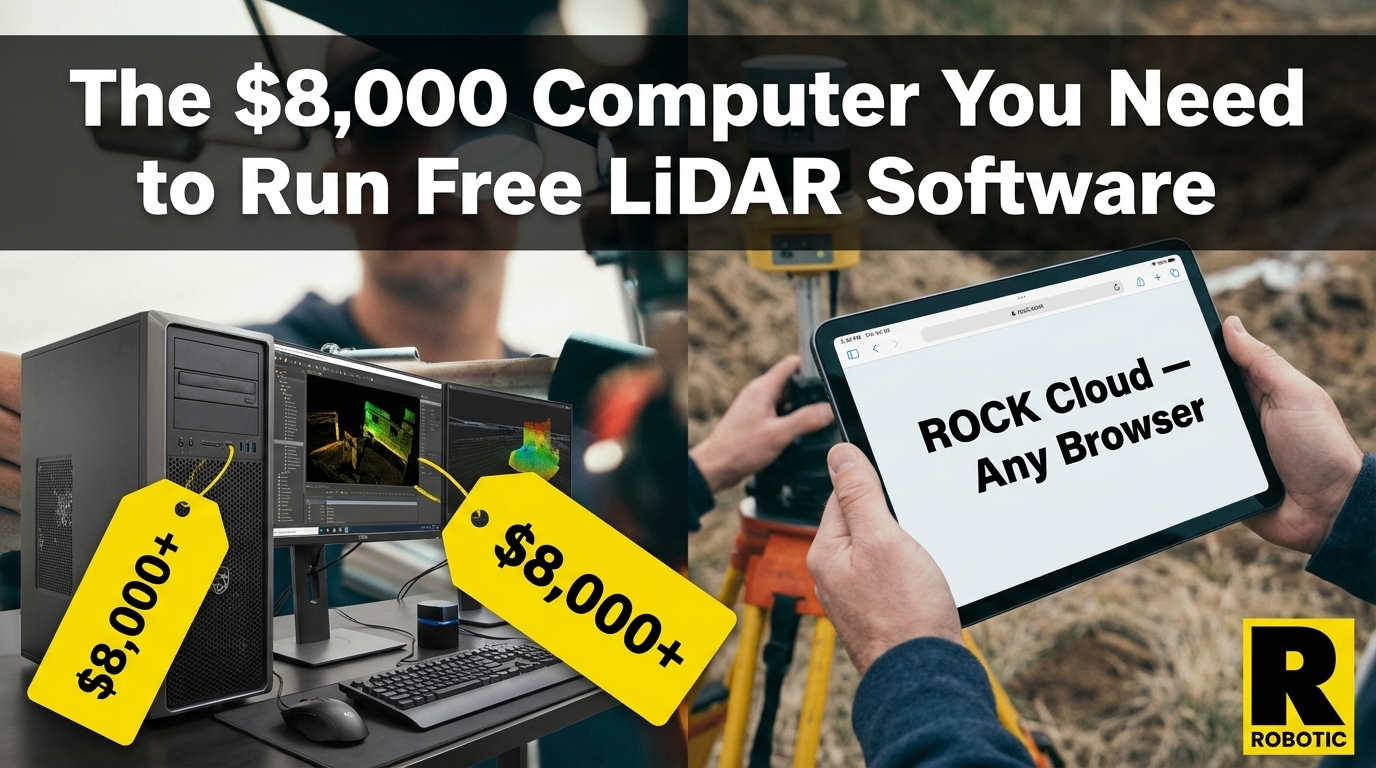
Software pricing is easy to compare. Annual subscription numbers are right there on the website — or at least a call away.
What software vendors never put on their pricing pages is the infrastructure that software requires to actually function. And for LiDAR processing, that infrastructure is expensive.
What LiDAR Processing Actually Requires
LiDAR is computationally brutal. A single flight over a 500-acre site can generate 50-200 GB of raw data. Processing that data — georeferencing, strip adjustment, classification, surface modeling — pushes hardware hard.
Here are the published minimum requirements for common LiDAR processing platforms:
DJI Terra (L3 processing):
- 32 GB RAM minimum; 64 GB recommended for L3 data
- NVIDIA GTX 1080 minimum; RTX 3080 or better recommended for L3
- NVMe SSD strongly recommended (HDD creates significant bottlenecks)
- Windows 10/11 only
LP360 (Drone tier):
- 32 GB RAM minimum; 64 GB+ for production use
- Dedicated NVIDIA GPU (CUDA support required)
- NVMe SSD for project storage
- Windows only
TerraSolid:
- 64 GB RAM minimum for large projects; 128 GB recommended
- NVIDIA workstation GPU
- Runs as a MicroStation plugin — requires a Bentley license in addition to TerraSolid licenses
- Large project batch processing can require workstations dedicated to overnight runs
Building a capable LiDAR workstation in 2026
| Component | Minimum Spec | Recommended Spec |
|---|---|---|
| CPU | Intel i7 or Ryzen 7 | Intel i9, Ryzen 9, or Threadripper |
| RAM | 64 GB | 128 GB |
| GPU | NVIDIA RTX 4070 | NVIDIA RTX 4090 or A-series |
| Storage | 2 TB NVMe SSD | 4+ TB NVMe RAID |
| Total cost | $3,500–$4,500 | $6,000–$10,000+ |
A workstation capable of actually running DJI Terra or LP360 at production volumes costs $4,000-$8,000 new. At real-world specs for a busy survey firm, budget closer to $5,000-$7,000.
And that workstation does not last forever. LiDAR datasets grow as sensors get better and project areas expand. A workstation that handles your current workflow may need an upgrade in 3-4 years. GPU generations turn over quickly; CUDA requirements for AI-accelerated processing advance.
Hardware replacement cost amortized over 4 years: $1,000-$2,500/year.
The Scaling Problem
Small datasets on a capable workstation work fine. The problem surfaces when your work grows.
A 50-acre commercial site: manageable. A 500-acre residential development: taxing. A 5,000-acre county-wide survey, a 200-mile utility corridor, or a client who wants the entire downtown core captured at 2 cm resolution: these can exceed what a single workstation can process in any reasonable time.
The workarounds are expensive in time:
Tiling — Breaking the project into geographic tiles, processing each independently, then stitching them back together. This adds hours of setup and assembly work, introduces seam artifacts at tile boundaries, and requires storage and organizational overhead that compounds on large projects.
Overnight runs — Locking your processing workstation for 12+ hours while a large dataset renders. During that time, your machine is unavailable for other work, your power bill goes up, and if something fails overnight, you lose the run time.
Queue management — If you have more than one project in flight, they compete for the same workstation. Rush projects get delayed waiting for the current run to complete.
The scaling problem doesn't solve itself with a bigger workstation. It solves itself with cloud infrastructure — where compute scales to the project, not the other way around.
The Full Infrastructure Cost
When you account for everything a desktop LiDAR processing setup actually costs, the number is significantly higher than the software license:
| Cost Category | Annual Cost |
|---|---|
| Software license (DJI Terra Pro, or LP360, etc.) | $2,040-$6,000 |
| Workstation (amortized over 4 years) | $1,000-$2,500 |
| Storage expansion (NVMe SSDs, external drives) | $300-$800 |
| IT support (or your time spent troubleshooting) | $500-$2,000 |
| Power and cooling (running a GPU workstation) | $200-$600 |
| Technician labor (30-60 hrs per project × 10 projects) | $12,000-$48,000 |
| Training for new staff | $500-$2,000 |
| Estimated Year 1 total (10 projects, 50 acres each) | $16,540-$61,900 |
That range is wide because the labor cost is the dominant variable — and labor cost depends on whether you're doing topo-only projects or full planimetric extraction. But even the low end is substantially more than the software license suggests.
ROCK Cloud: Zero Hardware Requirements
ROCK Cloud runs in a browser. Any browser. On any device.
The processing happens on ROCK's infrastructure — servers configured for LiDAR at scale, with no single-project constraints. A 5,000-acre corridor project gets the same treatment as a 5-acre subdivision: upload, order, receive deliverable.
You do not need:
- A dedicated workstation
- A high-end GPU
- NVMe storage arrays
- IT support for failed processing jobs
- Overnight rendering runs
When you order ROCK Pro Services, ROCK's team and ROCK's infrastructure handles the compute. Your contribution is the field data. Theirs is everything that turns it into a deliverable.
The cost comparison for the same 10 projects:
| Desktop Software + In-House | ROCK Cloud + Pro Services | |
|---|---|---|
| Software/platform | $2,040-$6,000 | $3,500 (ROCK Cloud) |
| Hardware | $1,000-$2,500 | $0 |
| IT/maintenance | $500-$2,000 | $0 |
| Processing labor | $12,000-$48,000 | $0 in-house |
| Pro Services cost | $0 (you do it yourself) | $1,500-$25,000 (varies by deliverable) |
| Total | $15,540-$58,500 | $5,000-$28,500 |
At topo-only deliverables, ROCK Cloud + Pro Services is dramatically cheaper. At full planimetrics for complex sites, the comparison tightens — but the in-house version requires significantly more time, introduces quality risk from technician variability, and doesn't scale when project volume spikes.
The Machine That Isn't There
There's a quiet cost that doesn't appear in any of these tables: the opportunity cost of infrastructure maintenance.
When your LiDAR workstation has a GPU driver conflict and your processing job fails, someone at your firm spends half a day troubleshooting. That time isn't billable. When a dataset exceeds your workstation's RAM and you spend an evening tiling and retiling a project, that's not billable. When your most experienced processor leaves and you spend three months training their replacement, that's not billable.
ROCK Cloud + Pro Services eliminates the machine that isn't there — the invisible infrastructure overhead that shows up as non-billable hours, delayed projects, and capacity constraints.
Your capital stays in field equipment, client relationships, and the work that generates revenue. The processing infrastructure stays with ROCK.